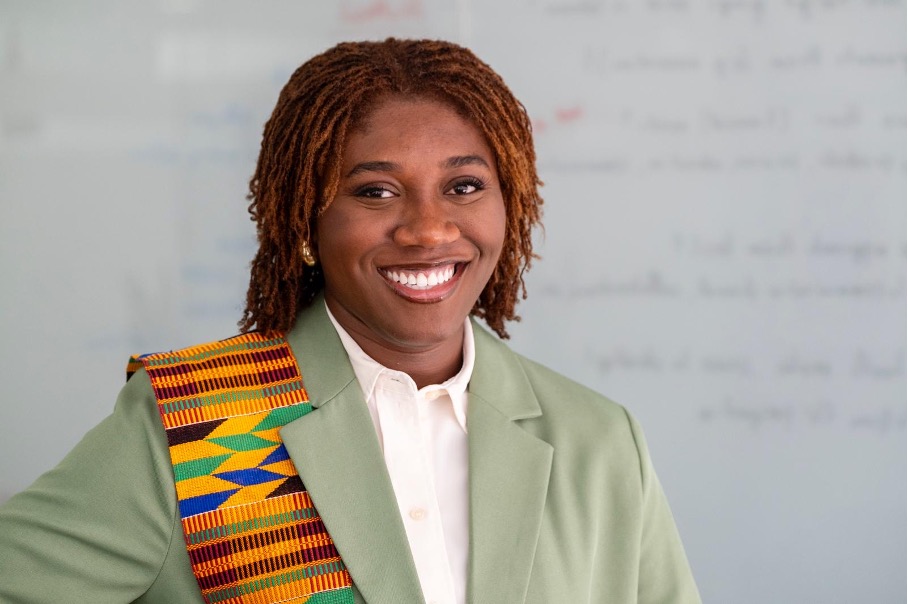
Lawrencia Akosua Pomaa
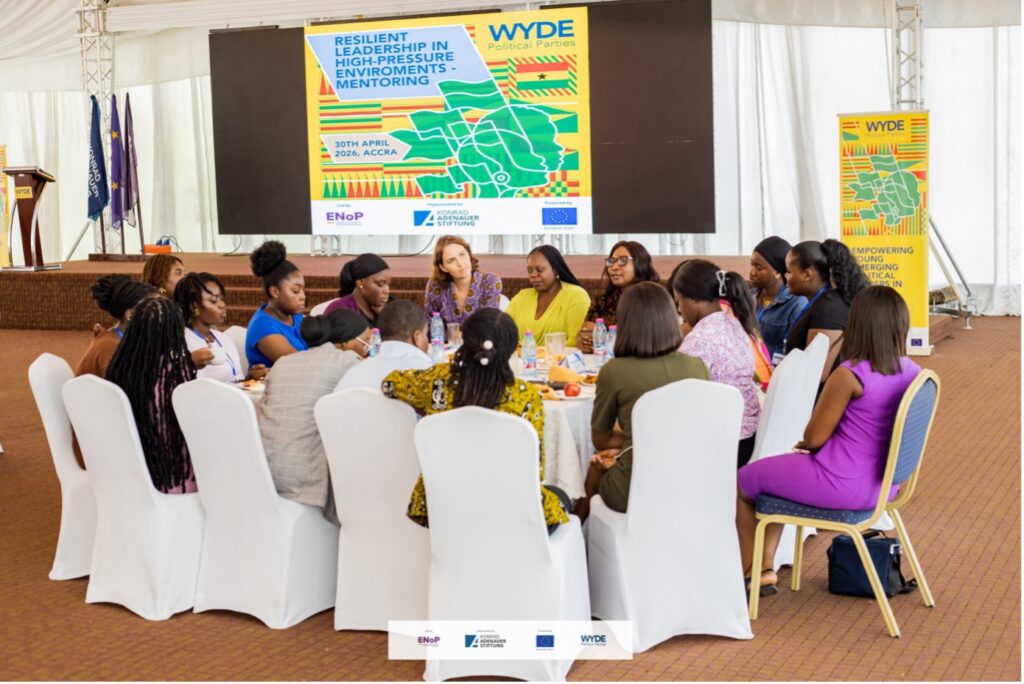
With a wealth of experience as Programme Manager at the Konrad-Adenauer-Stiftung (KAS) Ghana office, Lawrencia Akosua Pomaa has dedicated her career to advancing governance, youth engagement, and women’s empowerment. Through initiatives such as the EU WYDE project, she has worked closely with young leaders and communities, helping to shape programs that foster resilience, confidence, and active participation.
How do governance and policy frameworks impact women’s opportunities and wellbeing in Ghana? Are there gaps that could strengthen women’s participation and resilience?
Recently, Ghana launched the Affirmative Action (Gender Equity) Act, 2024 (Act 1121), which mandates at least 30% female representation in decision-making roles by 2026, with the goal of achieving full gender parity by 2034. Looking at Parliament, we currently have only 40 women out of 276 Members of Parliament, and women’s representation has remained persistently low, with only minimal changes over successive governments. The Affirmative Action Act is an important attempt to change exactly that.
In light of all our efforts to empower women and ensure that they are represented at the tables where impact and influence are exercised, I believe the Act is an important first step in tackling some of the institutional barriers that have kept women out of decision-making spaces. But I also think we need to look beyond the number and see the human being behind it. We should not see women simply as numbers to tick a box or fulfil a quota. We need to ensure that when women are given the opportunity to sit at the tables and corridors of influence, and are entrusted with power and authority, they are also equipped to exercise that leadership effectively.
Through my work, I have had the opportunity to work and engage with Ghanaian parliamentarians, and one message I hear repeatedly is: “We need training to build our capacities and equip us with both soft and hard skills.” This is an important observation.
We have been doing a much better job of helping women access positions of power, fight for those seats and enter spaces from which they have historically been excluded. But I think we have sometimes failed to recognise that the room changes once you enter it. The skills required to win a seat are not necessarily the same skills required to lead effectively once you have it.
That means investing in women not only to reach positions of influence, but to exercise and sustain leadership once they get there: developing their strategic thinking, communication, negotiation, policy, financial and organisational skills, while also building the confidence and resilience needed to navigate complex political environments.
For me, the next step in women’s empowerment is therefore not simply getting more women into positions of power. It is making sure that when they arrive, they are equipped to use that power well, influence decisions and lead with competence, confidence and integrity.
From initiatives like the EU WYDE project, what strategies work best to empower young women as leaders?
I think one powerful strategy is creating spaces where women do not feel that they have to choose between embracing their authenticity, empathy and softness and developing the qualities we have traditionally associated with masculinity: assertiveness, strategic thinking, confidence and authority. Women should be able to lead as themselves, while also developing the full range of skills required to lead effectively.
First, women need to see role models they can identify with; women who are authentic, relatable and accessible. They need to see women who can allow vulnerability to be visible without that vulnerability diminishing the power, competence or resilience they carry. I have found that mentorship rooted in proximity can be particularly powerful. Women often connect deeply with lived experiences that mirror their own, and sometimes seeing someone who has walked a similar path makes leadership feel more possible.
At the same time, I believe we need to take women’s own agency seriously. Not every woman wants to be a leader, and not every woman needs the same intervention. We should invest deeply in women who have a genuine desire to lead and a sense of purpose and self-motivation, because leadership development works best when there is an internal willingness to grow.
Secondly, we need to make leadership training practical. Young women need both the so-called “soft skills”, such as public speaking, communication, negotiation and leading people, and the hard skills required to manage resources, budgets, finances, projects and organisations.
But it is not enough to teach these skills in a classroom and expect them to translate automatically into leadership. We need to move away from predominantly frontal or theoretical learning and make empowerment programmes as practical as possible. Role plays, simulations, case-study analysis, parliamentary simulations, problem-solving exercises and real-life scenarios allow women to practise making decisions, communicating under pressure and navigating situations they will actually encounter.
Ultimately, I think the most effective programmes do three things: they give women someone to look up to, someone to walk alongside them, and the opportunity to practise what they are learning. That is where empowerment becomes capability.
How can community development programs better support women’s social, economic, and emotional needs?
We need to start by remembering that women are human beings before they are leaders, entrepreneurs, professionals or beneficiaries of any development programme. And human beings are deeply influenced by their mental and emotional wellbeing.
Sometimes, the barriers women face externally can also become internalised. When women repeatedly encounter environments that question their competence, authority or worth, it can affect their confidence and their sense of what they are capable of achieving. That is why I believe women’s emotional and psychological wellbeing needs to be taken seriously as part of leadership and community development.
This means creating spaces where women can process difficult experiences, build self-awareness, learn to navigate their emotions and develop healthy ways of dealing with pressure. Where appropriate, programmes should encourage access to professional counselling or therapy, and where cost is a barrier, development programmes could consider providing or subsidising access to qualified professionals. I see this as part of building the foundation for a more holistic and resilient leader.
Secondly, no one is an island. Women also need to learn how to build and use networks effectively. It is not simply about knowing people; it is about knowing how to build relationships, ask for support, exchange knowledge, find opportunities and create communities that can sustain you through different stages of your life and career. We need to teach women not only how to network, but how to build relationships that have genuine value and mutuality.
The same principle applies to economic empowerment. I believe we sometimes make the mistake of assuming that providing funding automatically creates empowerment. Capital is important, but capital without capability can be difficult to sustain. If we give someone money to start or grow something without equipping them with the skills to manage resources, budget, plan and build sustainably, we may not be giving them the tools they need to succeed.
That does not mean women do not need financial support. They do. But financial assistance should ideally be accompanied by financial literacy, mentorship, planning and practical guidance.
I have also encountered young leaders who are trying to participate in training programmes while dealing with very basic financial pressures in their own lives. Sometimes those immediate concerns make it difficult for them to fully focus on the opportunity in front of them. Community development programmes therefore need to look at the whole person rather than designing interventions around only one dimension of their lives.
For me, holistic empowerment means asking not only, “What opportunity are we giving this woman?”, but also, “What does she need in order to be able to take that opportunity, make use of it and sustain it?”
Based on your work, what approaches help women stay resilient under pressure or in leadership roles?
Having another network of women around them, letting them know what they are groning through can be overcome because they have been able to do so too. Teaching women to cry and embrace their emotions and release them but after some time suck up their mental resilience and put on their thinking hat and come up with strategy or a way of seeking help. We serve women a disfavour by killing emotions but we also serve them a disfavour by idolizing them.
Could you share an inspiring example of a woman’s leadership or perseverance?
I believe one of the most powerful things we can give women is a strong network of other women around them. Sometimes resilience comes from seeing someone else who has gone through what you are going through and realising, “If she overcame it, I can overcome it too.”
We also need to teach women that resilience does not mean suppressing emotions. We do women a disservice by killing emotions, but we also do them a disservice by idolising them. It is okay to cry, to feel, and to release what you are carrying. But after that, we need to put on our thinking hat, develop a strategy, seek help where necessary, and decide what the next step is.
To me, real resilience is not the absence of emotion. It is the ability to feel, recover and move forward with intention.
What advice would you give to women balancing public engagement, career, and personal growth?
I have come to believe that understanding that there is no perfect balance is the new balance. Life happens in seasons. There will be seasons when your career requires more of you, and others when personal growth, family or other areas of your life need greater attention. That is not failure; it is often healthy and necessary.
We have become very good at multitasking, but sometimes we need to give ourselves permission to focus. When you identify the most important task or goal in front of you and concentrate your energy on doing it well, you can often achieve more than by trying to do everything simultaneously.
The second is learning to delegate. As leaders, we need to understand that we cannot and should not do everything ourselves. Delegating to team members and using digital tools to outsource or simplify routine tasks can make a tremendous difference.
Finally, strategy and planning are essential forms of self-leadership. Before you can lead others, you have to learn to lead yourself, including your time, priorities and responsibilities. Something as simple as keeping a journal or planner, whether digital or traditional, and planning your day, week or month can help you stay focused while still leaving room to adapt.
Because ultimately, real resilience is not having everything under control. It is being able to withstand change without crumbling under it, to adjust, adapt and keep moving forward.
Your insights could inspire and support women, even if it touches just one person.
My final advice to women would be: take initiative and become a go-getter. Do not always wait for someone to come and mentor you, train you or open the door for you. Go looking for the knowledge, the opportunities and the people who can help you grow. There are so many resources available to us today, especially online and often for free, that we should make use of them.
And most importantly, take yourself seriously. No one will take you seriously if you do not first take yourself seriously. Other people will value your work, your time and your contribution when you learn to value them yourself.
Know what you bring to the table. Invest in yourself. Ask questions. Seek opportunities. Build relationships. And when the door opens, be prepared to walk through it.
Do not wait to be chosen. Start choosing yourself.
Links:
https://www.instagram.com/kas.ghana
https://www.linkedin.com/in/pomaa
https://mobile.ghanaweb.com/GhanaHomePage/NewsArchive/Investing-in-young-political-leaders-is-investing-in-Ghana-s-future-Lawrencia-Akosua-Pomaa-2046812