
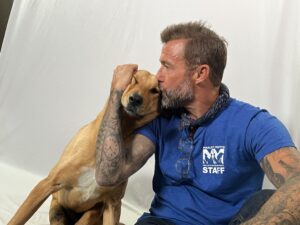
Zach Skow is the founder of Marley’s Mutts Dog Rescue, a California-based nonprofit dedicated to rescuing at-risk dogs, and he also co-created the Pawsitive Change program, which pairs rescue dogs with incarcerated individuals to foster mutual rehabilitation and personal growth. In 2008, Zach was diagnosed with end-stage liver disease at the age of 28, and his rescue dogs, Marley, Tug, and Buddy, played a crucial role in his recovery, providing emotional support and motivation. Through lifestyle changes and the bond with his dogs, his health improved, and he no longer required a liver transplant. Today, Zach serves as Director of Community Relations and Development at Caravita Foundation, where he continues his dedication to animal welfare and community outreach.
How did your own journey of recovery inspire the creation of Marley’s Mutts?
My recovery and my rescue work grew up together; they are inseparable. I started volunteering at the Mojave Animal Shelter in 2000 and instantly fell in love with shelter life. At the time, I was deep in addiction to drugs and alcohol and in a very desperate place. The dogs brought me a kind of peace I hadn’t felt in years, a steady presence amid the chaos.
By 2008, my health collapsed: my liver, kidneys, gallbladder, and pancreas were failing. I spent six weeks at Bakersfield Memorial Hospital, grew sicker, became dependent on morphine and dilaudid, and nearly lost my life. I needed a liver transplant, but I didn’t qualify because I hadn’t achieved six months of sobriety. In what felt like a last-chance move, I was admitted into the comprehensive transplant program at Cedars-Sinai and sent home with one clear condition: six months sober if I wanted a chance at the operation.
“Without recovery, I never would have entered animal rescue, and without the dogs and the work of rescue, I never would have recovered.”
Coming home was terrifying. I was suicidal and had no idea how to live without drugs or alcohol. My dogs literally kept me alive. During the brutal two-day opioid withdrawal, they were there, offering unconditional love when I could barely stand. They breathed life into me and reminded me I was worth fighting for.
Recovery and animal rehabilitation require the same things: rules, boundaries, discipline, exercise, affection, and love. As I learned to give those things to myself, I also learned to give them to the dogs. I began fostering constantly and volunteering at every local shelter I could. Week by week, the fog lifted, the ascites in my belly diminished, and my body and mind started to heal. After six months, I no longer needed a transplant. I was, by any measure, a miracle of that program. That mutual healing is the heart of Marley’s Mutts.
What role did Marley and your other dogs play in helping you through that time?
Marley was the cornerstone of my little pack. I used to call him my “Pack General.” He kept the peace and held our dynamic together while I worked to heal myself and help the dogs heal. Because I was socially anxious and terrified of being in public, Marley went everywhere with me. He was the bridge that helped me step back into the world, giving me the confidence to speak in schools, colleges, recovery centres, and homeless shelters.
There was a night I remember as my absolute lowest. I woke up after an episode of severe illness and found myself physically broken and terrified. I barely recognised the person in the mirror. For the first time, I had truly settled on ending my life. But in that bathroom, my three dogs were with me. They looked up with such uncomplicated, unquestioning love, as if I were the most important person on earth. In their eyes, I wasn’t sick, I wasn’t broken, and I wasn’t disposable. They saw me as someone worth fighting for. That moment changed everything.
“Marley and the dogs healed me, and in healing them I found my purpose.”
Their quiet loyalty taught me how to love and be disciplined, and that lesson is at the heart of everything I do.
What’s one story, of a dog or a person, that best captures the mission of Marley’s Mutts?
Hooch’s story embodies the heart of Marley’s Mutts. He came to us as a severely abused fighting dog, with his tongue cut out, starving, and near death in a shelter, because he couldn’t eat, drink, or regulate his body temperature. He weighed just 36 pounds and was wasting away. Through months of patient care and rehabilitation, we taught Hooch how to eat and drink without a tongue. Against all odds, he not only survived but thrived, eventually reaching a healthy 87 pounds. Hooch went on to become a certified therapy dog, touching the lives of hundreds, if not thousands, of people. Before Hooch, dogs with severe tongue injuries were routinely euthanised. Hooch proved to the world that, with love, innovation, and commitment, a dog once considered “unadoptable” could live a long, happy, and meaningful life. That’s the mission of Marley’s Mutts, to see potential where others see impossibility, and to fight for every dog’s chance at life.
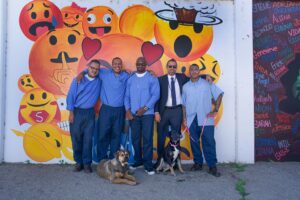
The Pawsitive Change program gives incarcerated individuals a sense of responsibility and purpose through training rescue dogs. Based on your experience, what personal transformations do you most commonly see in participants by the end of the program?
What I’ve seen manifest in others through the program is a complete trajectory change. Students often move from a rut of drug use and illicit behaviour into a groove of structured programming, education, empathy, and sobriety. Many of our graduates, nearly 30, have joined the pet industry as trainers and professionals. Fundamental changes often occur at the spiritual level, creating an entirely different perspective and attitude moving forward.
What has been the most surprising lesson you’ve learned about the healing bond between humans and dogs?
I’ve never been surprised by the healing power of dogs. I’ve always felt it, always known it firsthand. What has surprised me is how many people have opened their hearts to that truth and made rescue, shelter work, and animal advocacy a part of their own lives. Over the years, I’ve watched society move toward deeper compassion and awareness, with more people engaging in rescue, pushing for stronger animal welfare policies, and celebrating the role dogs play in our healing. I’m proud that, through the stories we’ve shared, Marley’s Mutts and Pawsitive Change have played a part in bringing attention, energy, and love to this movement.
What message of hope would you share with someone who feels broken or in need of a second chance?
What helps most in recovery is finding purpose, that sweet spot where what you’re good at intersects with what you love and what fills your heart. Recovery without purpose can feel empty and impossible, but when you discover something to root yourself in, it can carry you forward even when it feels like there’s no wind in your sails. Hope is found in purpose, and purpose is what reminds us that our lives still matter, still have meaning, and are worth fighting for.
Zach Skow
Founder of Marley’s Mutts
Director of Outreach, Caravita Foundation
Follow Zach Here: https://www.instagram.com/zachskow/?hl=en