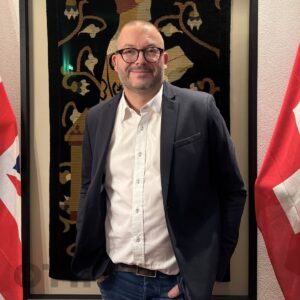
Martin Coul
Martin Coul’s journey to creating The Hushed is rooted in both professional experience and personal understanding. His career has taken him through technology and global communications, including work connected with the development of the smartphone industry and Skype. But alongside this professional journey, Martin has experienced the impact of mental health much closer to home.
Losing a parent to schizophrenia as a young child and later navigating his own experiences of depression and PTSD shaped how he understood mental health, not as theory, but as lived reality. These experiences have shaped the way he sees mental health, not simply as something we talk about when things go wrong, but as something that affects families, relationships and the way we connect with one another.
Alongside his professional work, Martin co-hosts or leads several voluntary mental health initiatives. These have helped raise nearly CHF 20,000 for charity while creating spaces where difficult conversations can happen more naturally.
Given that Martin is on record as saying he dislikes the sound of his own voice, he never set out to host a podcast. It was Elaine Pringle Schwitter, host of Heads Talk, who encouraged him to create what subsequently became The Hushed, telling him, “We need a voice in this space.”
What followed is The Hushed, a podcast by men, for men, and those who love them. Men leave their titles and expectations at the door and talk honestly about life as they have experienced it. Mental health often sits somewhere in these stories, but it is rarely the whole story. The conversations can be funny, heart-breaking and often both.
Was there a defining moment that made you feel these conversations needed to happen?
There was a defining experience rather than a single moment. Each November, I take my Martin & Guests’ Movember Grand Tour around Switzerland, creating informal spaces where men can come together and have conversations we often avoid.
What increasingly frustrated me was the disconnect. Online, people would like, share and tell me how important the subject was, yet getting men to physically cross the threshold was incredibly hard. Corporates would tell me, “We don’t talk about men’s mental health here,” while privately the need was clearly there.
Yet I have also seen that men will walk together, shoulder to shoulder, and conversations begin almost naturally.
That made me question the assumption that men simply won’t talk. We need different pathways and different conditions in which to make talking feel possible. The Hushed became one of those quieter ways in.
What do you hope men, and the people who care about them, take away after listening to an episode?
What I hope for most is recognition. For a man listening, it might simply be, “I’m not the only one who thinks or feels like this.” For a partner, friend or family member, it might be understanding the man beside them a little better. The Hushed is not about providing neat answers or inspirational stories with everything tied up at the end.
Through your conversations, what have you learned about men’s mental health that surprised or challenged your own assumptions?
One thing that has surprised me is just how good men can become at masking. Someone can still go to work, make people laugh, support a family and appear completely in control while privately things are beginning to unravel.
I have also been struck by how articulate men can be when they feel safe enough to speak. Men are not nearly as bad at talking as we keep telling them they are. They have simply become very selective about where, when and with whom they take the mask off.
Many people avoid difficult conversations around grief, vulnerability and well-being.
Why do you think these topics are still so hard to talk about?
Silence is rarely empty. Often it is a calculation about what honesty might cost. We praise vulnerability in theory, yet people still worry that admitting grief, fear or struggle might change how others see them.
I have seen the opposite through co-hosting 14 Death Cafés in Zug. We invite complete strangers to sit together, drink coffee, eat cake and talk about death. There is no agenda and no attempt to fix anything. Yet people talk with extraordinary openness.
That has taught me that difficult subjects are not necessarily impossible to discuss. Context matters enormously. “My door is always open” is not the same as somebody believing they can walk through it.
People do not always need an answer. They need a space where the difficult thing is allowed to be said out loud.
Has there been a guest or a story that has stayed with you long after the interview?
What made it so memorable? It is rarely the dramatic parts of a story that matter most to me. More often, it is one simple sentence or image that suddenly gives language to something much bigger. When I asked Pete on S2/E1 what positive masculinity meant to him, his answer was simply: “Safety.”
In S2/E4, Ewald described sitting at a petrol station crying because he was struggling so badly, before pulling himself together, driving on to a meeting and trying to impress the people in the room as though nothing had happened.
And Dale, who has survived multiple suicide attempts, described his suicidal thoughts as not being his own in S2/E2. He spoke about his illness taking him somewhere he did not actually want to go.
Why have you chosen illustration over photography for The Hushed?
Photography can be incredibly powerful, but for subjects like mental health, identity and masculinity it can also make an issue feel very literal. A photograph of a distressed man or teenager inevitably asks the viewer to interpret that particular face, expression and situation.
Illustration creates a little more psychological distance. It leaves more room for someone to recognise an emotion or experience in their own way, rather than feeling that one person is being asked to represent it.
For The Hushed, I wanted the imagery to reflect the same nuance as the conversations. The visual language also evolves from season to season, giving each chapter of the podcast its own character while remaining recognisably part of the same world.
How has hosting The Hushed changed you, both personally and professionally?
Personally, I have finally become more comfortable with the sound of my own voice. The Hushed has turned out to be my own slightly unconventional form of exposure therapy.
It has also given me a little more solid ground, even if I still wobble. Some industry estimates suggest only around 8% of podcasts make it beyond ten episodes. The Hushed has done that with zero marketing budget and is now heard in more than 50 countries.
More importantly, it has changed the way I listen. I am more comfortable with silence, less inclined to rush in with an answer and more curious about what sits underneath someone’s first response.
Professionally, it has reinforced my belief that people rarely go from “fine” to crisis overnight, and made me less interested in having the right answer and much more interested in asking a better question.
What do you do when you’re not talking about men’s mental health?
Men’s mental health is only one part of the work. Through OTII®, I help organisations and educational institutions take the guesswork out of measuring well-being, understand where pressure is building and why, and act earlier.
I tend to lean into the subject’s others avoid. That can mean psychosocial risk, menopause, mental health literacy, grief, workplace culture or schools, helping people make sense of what is going on beneath the surface.
The common thread is always the same: evidence, understanding and action.
If you could leave readers with one message about being human, vulnerability, or supporting others, what would it be?
We put a lot of responsibility on the person who is struggling to reach out, often at exactly the point when doing so feels hardest. That is especially true for many men, who have grown up believing we should be able to find the solution ourselves.
The answer cannot only be encouraging people to reach out. We also have to become better at noticing, reaching in and making it safer to tell the truth before breaking point.
And you do not need to have the answers. You do not need to fix somebody. You just need to be willing to notice that something is not quite right, ask the second question and be prepared to listen.
Finally, what does ‘strength’ mean to you?
I used to associate strength much more with endurance: carrying the load, pushing through, keeping going and not letting people down. I now think that is only one version of strength, and occasionally a dangerous one.
Strength can also be saying, “I need help”, “I got that wrong”, “I’m frightened” or “I can’t do this alone.” Real strength is being secure enough in who you are that you no longer need to prove how strong you are.
And, as Ewald put it so eloquently on S2 / E4, “there are no penalty points in life for asking for help.”
Podcast Link to S2 E1
https://open.spotify.com/episode/4VYicyhDO2eIfaRIabJocc?si=4KpOlCWJRsO4CxBlnG-HAQ
LinkedIn https://www.linkedin.com/in/coulmc/
OTII https://www.otii.io